Benefits of Removable Insulation Covers
Removable insulation covers offer numerous advantages in various settings. Firstly, they play a significant role in energy conservation. By providing effective insulation, they reduce heat loss or gain, which helps in lowering energy consumption and subsequently cutting down on energy costs. For example, in industrial facilities with numerous pipes and equipment, these covers can prevent heat dissipation from hot surfaces, making the heating or cooling systems more efficient.
Secondly, they are crucial for protecting equipment. They act as a shield against external factors like physical impacts, dust, and moisture, which can potentially damage the equipment and shorten its lifespan. In addition, removable insulation covers enhance workplace safety. They reduce the risk of employees accidentally touching hot surfaces and getting burned, thus creating a safer working environment. Moreover, some of these covers also have the function of noise reduction, which is beneficial in areas where excessive noise from operating machinery could be a nuisance.
Factors to Consider When Making Removable Insulation Covers
When manufacturing removable insulation covers, several factors need to be taken into account. One of the most important aspects is the operating temperature range. Different applications may involve exposure to high temperatures, and the chosen materials must be able to withstand these without degrading or losing their insulating properties. For instance, in industrial processes where hot steam or chemicals are involved, the materials should maintain their integrity under such extreme heat. Note that when we talk about temperature, we usually consider both Celsius (°C) and Fahrenheit (°F). The conversion formula between them is F=C×(5/9)+32.
Another factor is moisture. In some environments, like outdoor or humid indoor settings, the insulation covers might be exposed to moisture. Materials that are moisture-resistant are preferred as moisture can affect the thermal performance and durability of the covers. Also, the chemical resistance of the materials matters. If the covers are likely to come into contact with chemicals, they should be able to resist corrosion and chemical reactions to ensure a long service life.
Most importantly, a qualified insulation cover must not contain asbestos. Asbestos is known to be a harmful substance that can cause serious health issues when its fibers are inhaled, so it is essential to use asbestos-free materials in the production of these covers.
Choosing Materials for Removable Insulation Covers Based on Temperature Ranges
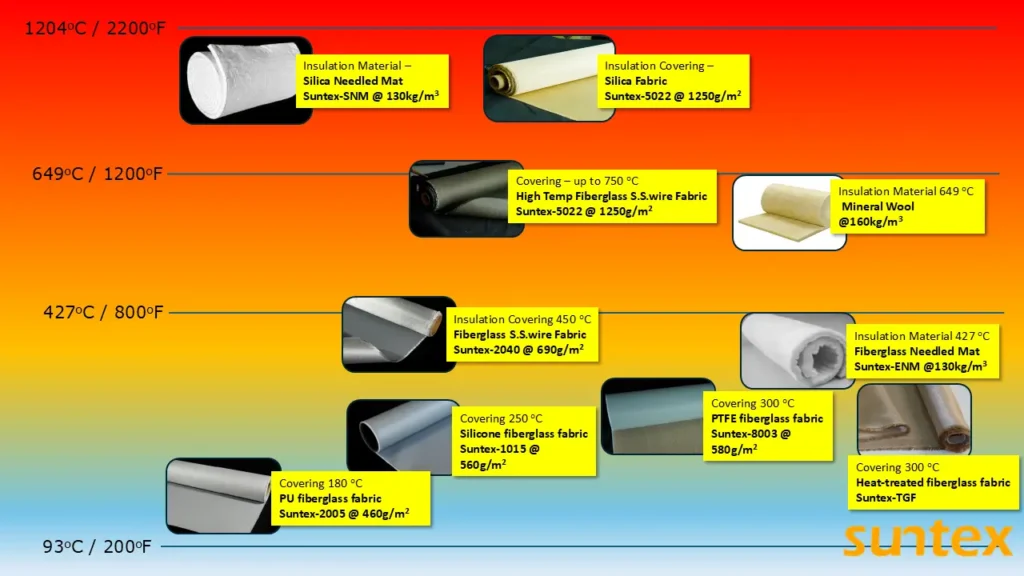
Fireproof Insulation Materials for Temperature Range: 93°C – 427°C (200°F – 800°F)
- PU Coated Fiberglass Fabric, Suntex-2005, for Outer Layer & Inner Layer:
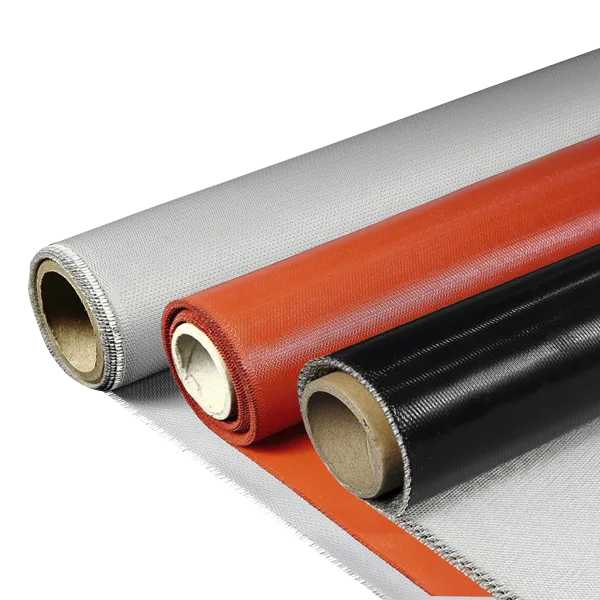
This material can be used for both the outer layer and the inner layer of the insulation covers. It has several notable features. It is flame retardant, anti-fray, easy to fabricate, and has good abrasion resistance. It is a suitable choice for low-budget projects. However, it has some limitations. It is only applicable for indoor and dry environments. The PU coating has a maximum temperature resistance of 180°C (356°F), while the base fiberglass fabric can withstand up to 550°C (1022°F). But when the temperature reaches 427°C (800°F), its strength retention rate is only about 50 – 60%. And when the temperature exceeds 550°C (1022°F), the strength retention rate drops to only 20%. If it is used for the inner layer, it is recommended that the maximum operating temperature does not exceed 200°C (392°F). - Silicone Coated Fiberglass Fabric, Suntex-1015, for Outer Layer & Inner Layer:
Also suitable for both outer and inner layers, this material is flame retardant, moisture-proof, oil-proof, weather-resistant, anti-fray, flexible, and easy to fabricate, maintain, and clean. It is one of the preferred materials for making insulation covers and can be used in both indoor and outdoor environments, able to endure harsh cold and hot conditions. The silicone coating has a maximum temperature resistance of 250°C (482°F), and the base fiberglass fabric can tolerate up to 550°C (1022°F). Similar to the previous one, at 427°C (800°F), its strength retention rate is around 50 – 60%, and after exceeding 550°C (1022°F), it drops to 20%. When used for the inner layer, it is advisable to keep the maximum temperature below 250°C (482°F). - PTFE Impregnated Fiberglass Fabric, Suntex-8003, for Outer Layer & Inner Layer:
For the outer and inner layers as well, this material is resistant to acid and alkali corrosion, waterproof, anti-static, anti-fray, and easy to fabricate and clean. It is also a top choice for insulation cover production and can be used in various indoor and outdoor situations. The PTFE coating has a maximum temperature resistance of 300°C (572°F), and the base fiberglass fabric can withstand up to 550°C (1022°F). At 427°C (800°F), its strength retention rate is about 50 – 60%, and beyond 550°C (1022°F), it reduces to 20%. When used for the inner layer, the recommended maximum temperature is 300°C (572°F). - Heat Treated Fiberglass Fabric, Suntex-TGF, for Inner Layer:
Primarily used for the inner layer of reusable insulation covers, it has the advantage of being inexpensive and producing no smoke during use. It is usually applied in the temperature range between 200°C (392°F) and 300°C (572°F). However, it has drawbacks such as having no coating, generating flying fluffs when cut, which is not conducive to production. - Fiberglass Needled Mat, Suntex-ENM, for Insulation Material:
It is a commonly used insulation material within a temperature range of up to 500°C (932°F). Made of E-glass fibre with a density of about 130 kg/m³ and a thermal conductivity of 0.04 W/m·K at 200℃ (392°F), it is non-combustible and maintains acceptable strength up to 427°C (800°F). Thanks to the E-glass, it has low thermal conductivity and is resistant to many solvents and acids.
Fireproof Insulation Materials Temperature Range: 427°C – 649°C (800°F – 1200°F)
- Mineral Wool, For Insulation Material:
This material has a neutral pH and a density of about 160 kg/m³, with a thermal conductivity range of about 0.03 – 0.04 W/m·K. It is an excellent thermal insulation material that can also offer noise reduction and sound absorption. Moreover, it is non-combustible. In this temperature range, it is often used as an insulation material or for the inner layer. - PU Coated Fiberglass Fabric with s.s. Wire Reinforced, Suntex-2040, for Inner Layer:
Benefiting from the PU coating, it is easy to fabricate and has enhanced abrasion resistance. Its base fabric is reinforced with 316 stainless steel wire, which enables it to maintain relatively high strength even after exceeding 300°C (572°F). Therefore, it is suitable for the temperature range of 300°C (572°F) – 500°C (932°F). - High Temperature Fiberglass Fabric with s.s. Wire Reinforced, Suntex-5058, for Inner Layer:
It features a special high-temperature-resistant coating that significantly improves the high-temperature performance of the glass fiber fabric after exceeding 400°C (752°F). Meanwhile, the 316 stainless steel wire further strengthens the fabric, allowing it to withstand long-term working temperatures exceeding 700°C (1292°F). Even in complex high-temperature and vibration environments, it can ensure the integrity of the fabric.
Fireproof Insulation Materials Temperature Range: 649°C – 1204°C (1200°F – 2200°F)
In this high-temperature range, silica fiber is the best choice.
- Silica Needled Mat, Suntex-SNM, for Insulation Material:
It is a commonly used insulation material within the temperature range of 700°C (1292°F) – 1200°C (2192°F). Made of 100% silica glass fiber with over 96% SiO₂, a density of about 130 kg/m³, it is 100% inorganic fiber, non-combustible, has high porosity, excellent sound absorption, low heat shrinkage, and low heat loss. - Silica Fabric, Suntex-5022, for Inner Layer:
Often used as the inner layer, it can withstand temperatures exceeding 1000°C (1832°F). Its surface is usually coated with vermiculite, which can expand under high-temperature conditions to form a dense protective layer. This enhances its performance at high temperatures and also makes it easier to cut.
In conclusion, choosing the right materials for removable insulation covers based on the temperature range is essential to ensure their effectiveness and durability in different applications. By understanding the characteristics of various materials in different temperature intervals and considering both Celsius and Fahrenheit scales, we can make more informed decisions to meet specific requirements and achieve optimal insulation results.