Industry Insights: How the AI & Electronics Revolution is Reshaping the Supply Chain and Driving Upstream Fiberglass Yarn Costs
Read More >>
How to go to Suntex?
Why is Suntex a reliable supplier?
Besides competitive prices, what else can Suntex provide?
What are Suntex's products?
Looking for any help?
Fiberglass fabric has been a significant material in many industrial applications, and it’s essential to understand its capabilities when it comes to heat insulation.
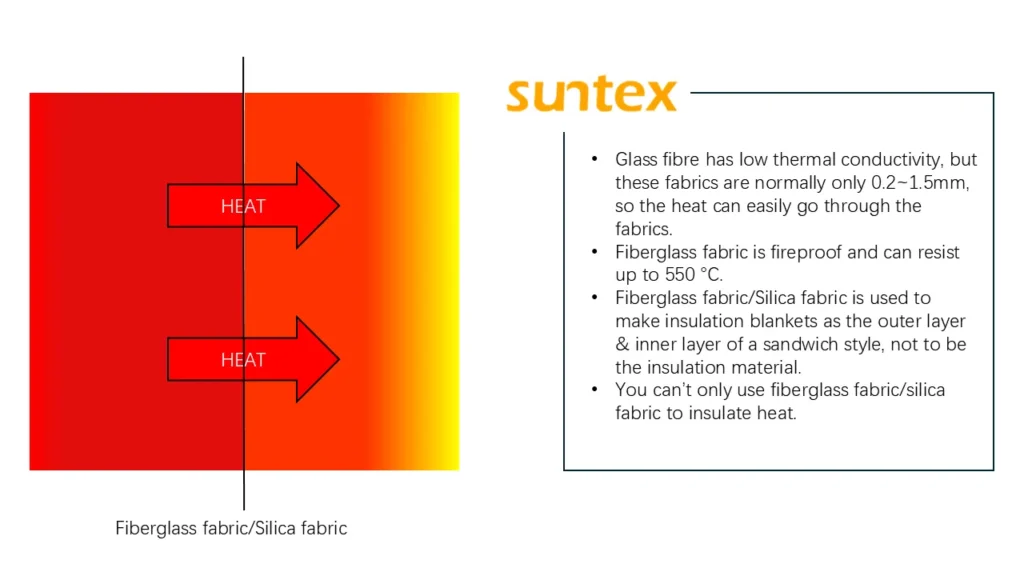
Fiberglass fabric is well-known for its remarkable properties. Firstly, it is fireproof, which provides crucial protection in various settings where fire hazards are a concern. For example, in industrial facilities, power plants, or even some building structures where there could be potential fire risks, fiberglass fabric can play an important role in preventing the spread of fire. Moreover, it has the ability to resist relatively high temperatures, being able to withstand up to 550 °C. This high-temperature resistance makes it suitable for applications where exposure to heat is inevitable.
Among fiberglass fabrics, silica fabric stands out as a specialized variant. Defined by its SiO₂ content exceeding 96%, silica fabric significantly surpasses standard fiberglass in thermal performance, boasting a temperature resistance of up to 1000 °C. This enhanced heat tolerance expands its applicability to more extreme high-temperature scenarios, such as furnace linings or aerospace components facing intense thermal conditions.Another important characteristic of fiberglass fabric is its low thermal conductivity.
In theory, materials with low thermal conductivity are good at impeding the transfer of heat. However, when it comes to fiberglass fabric, there is a limiting factor – its thickness. The thickness of fiberglass fabric usually ranges from 0.2mm to 1.5mm. Despite having the advantage of low thermal conductivity, this relatively thin nature means that the heat can easily go through the fabrics. Heat transfer mainly occurs through conduction, convection, and radiation. In the case of conduction, with such a thin layer of material, there isn’t sufficient physical barrier to effectively block the heat from passing from a higher temperature side to a lower temperature side. It’s like having a very thin wall trying to stop something from moving through; it just doesn’t have enough substance to create significant resistance.
Fiberglass fabric or silica fabric is often used in a specific way in the context of insulation. They are commonly utilized to make insulation blankets as the outer layer and inner layer of a sandwich style. In this kind of construction, they are not the main insulation material itself. Instead, they act as protective layers that enclose and hold the actual insulation materials in place. For instance, in an insulation setup for a pipe or a piece of equipment, fiberglass fabric might form the outer and inner skins of a structure, while other materials with better insulation properties, such as fiberglass needle mat or mineral wool, are placed in between to do the actual job of reducing heat transfer.
It’s important to note that you can’t solely rely on fiberglass fabric or silica fabric to insulate heat effectively. Given their thinness and the fact that heat can relatively easily penetrate them despite their other beneficial properties, they need to be combined with proper insulation materials in a well-designed structure to achieve satisfactory insulation results.
Choosing the Right Insulation Materials
To achieve good heat insulation, it is crucial to use the correct insulation materials. There are several excellent options available in the market that are specifically designed to minimize heat transfer and provide effective insulation.
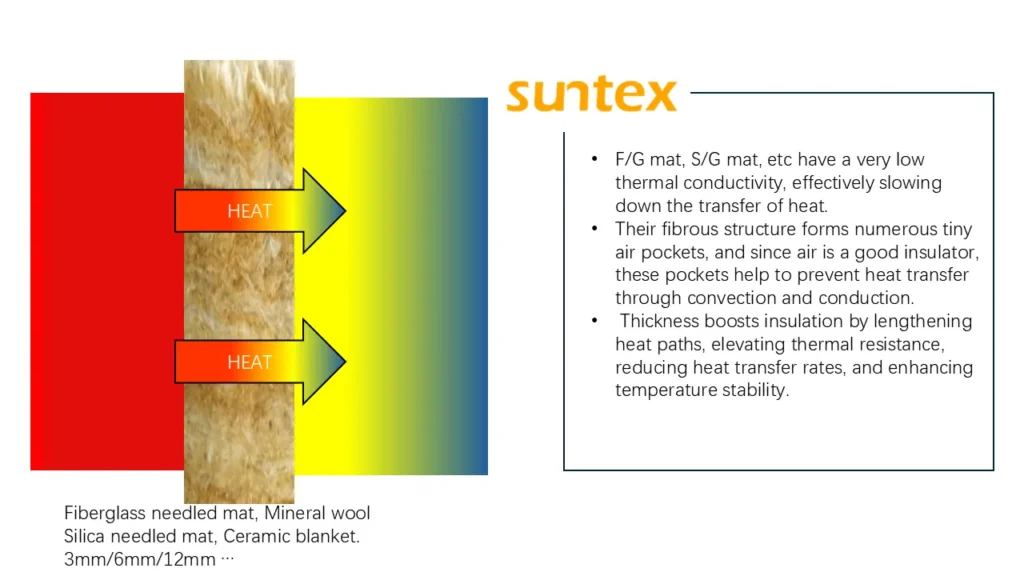
Fiberglass needled mat is a popular choice for insulation purposes. It has a porous structure where the fibers are intertwined, creating numerous small air pockets within it. As air is a poor conductor of heat, these air pockets play a vital role in slowing down the heat transfer process. The mat can maintain its integrity and insulation properties over a wide range of temperatures, making it suitable for various applications, whether in industrial settings or in some domestic insulation requirements.
Mineral wool is another remarkable insulation material. Its fibrous structure with a certain density contains a plethora of air spaces. Besides this advantageous structure, it also has inherent excellent thermal properties. It can act as a strong thermal barrier, effectively reducing heat transfer between different temperature zones. Mineral wool is widely used in buildings, industrial plants, and many other places where heat insulation is of great importance.
Silica needled mat is often utilized in high-temperature insulation applications. Made from materials with outstanding thermal resistance properties, it has a structure that allows for efficient heat trapping. The arrangement of its fibers is designed to minimize heat conduction through the material, maximizing the heat-insulating effect. It can withstand relatively high temperatures and is commonly found in applications where extreme heat needs to be managed, such as in some high-temperature industrial processes or in certain specialized equipment insulation.
Ceramic blanket is known for its exceptional heat resistance and insulation capabilities. It is typically made from ceramic fibers that can endure extremely high temperatures without significant degradation. The blanket’s structure provides a dense yet porous medium that effectively blocks heat transfer. It is widely used in industries like metallurgy, aerospace, and furnace manufacturing, where dealing with intense heat is a regular occurrence.
In conclusion, while fiberglass fabric has its merits like being fireproof and having high-temperature resistance along with low thermal conductivity, its limitations in terms of thickness mean that it is not a stand-alone solution for heat insulation. Understanding these aspects helps us make more informed decisions when it comes to choosing and using materials for different insulation and heat-resistant applications. By selecting the right insulation materials such as fiberglass needled mat, mineral wool, silica needled mat, and ceramic blanket, we can ensure better heat insulation and meet the specific requirements of various projects.
I hope this blog post has provided you with some useful insights into the role and characteristics of fiberglass fabric in the world of heat insulation. Stay tuned for more discussions on industrial materials in the future!
Tag:
Other FAQ / Blogs / News >>