Industry Insights: How the AI & Electronics Revolution is Reshaping the Supply Chain and Driving Upstream Fiberglass Yarn Costs
Read More >>
How to go to Suntex?
Why is Suntex a reliable supplier?
Besides competitive prices, what else can Suntex provide?
What are Suntex's products?
Looking for any help?
With 20 years of experience in the high-temperature textile material industry, Suntex has witnessed market evolution and also observed practices that harm industry credibility. Among these, the “low-price trap” for high silica fabric is particularly alarming. Today, we reveal the truth behind this industry issue.
In recent years, Suntex has received numerous inquiries for high silica fabric, with customers clearly specifying requirements for silica fabric that can withstand temperatures exceeding 1000°C. Based on our two decades of industry experience, such requirements undoubtedly call for high silica fabric—after all, in high-temperature protection applications, only high silica fabric can stably withstand temperatures above 1000°C among silica-based fabrics. However, it is puzzling that most of these inquiries ultimately result in customers choosing much lower-priced products from other suppliers.
As a professional high-temperature textile manufacturer, we have a responsibility to warn all buyers: any silica fabrics or vermiculite coated silica fabrics sold at “ultra-low prices” are likely involved in raw material fraud. Suppliers offering prices far below the reasonable market range do not provide the high silica fabric you actually need—instead, they pass off medium silica fabric or E-glass fiber fabric as “fake high silica fabric.”
To identify this fraud, it is first necessary to clarify what constitutes genuine high silica fabric. There is a strict industry standard: only silica-based fabrics with a silica (SiO₂) content exceeding 96% can be called high silica fabric. This extremely high silica content is the core support for its excellent high-temperature resistance—only fabrics meeting this standard can maintain stable physical properties and protective effects in high-temperature environments above 1000°C, without decomposing, melting, or losing protective capabilities due to high temperatures.
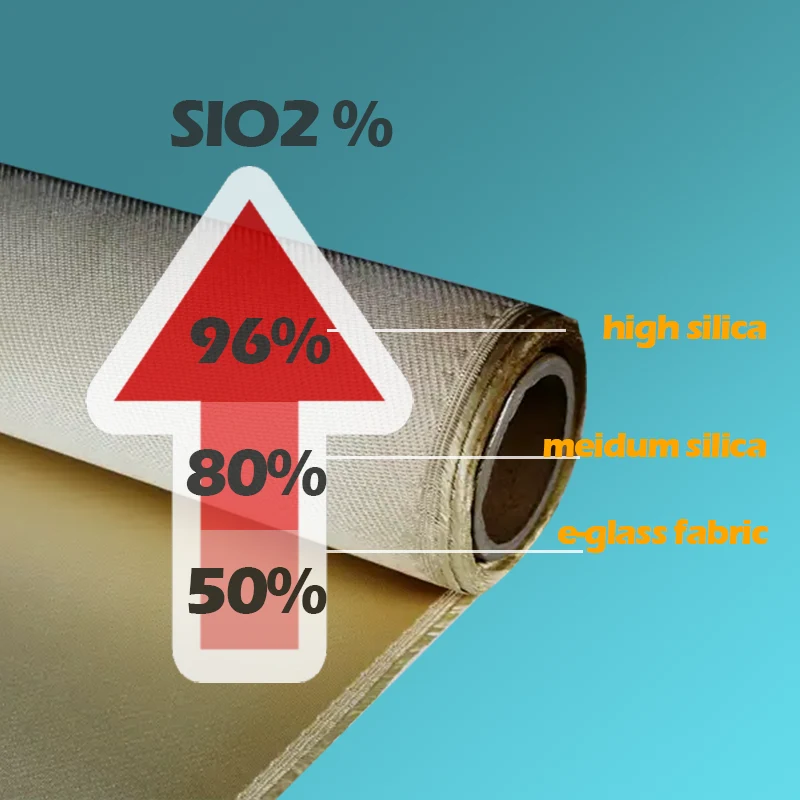
The “substitutes” used to pass off as high silica fabric, however, have vastly different performance. First, medium silica fabric typically has a silica content between 60%-80%, far below the standard for high silica fabric. Its temperature resistance is also significantly reduced, only withstanding 600°C-800°C. Once the temperature exceeds this range, the fabric will gradually soften, deform, and lose its protective function.
E-glass fiber fabric has an even lower silica content, generally around 50%, with a maximum temperature resistance of only 450°C-550°C. As a common ordinary glass fiber fabric, it is mostly used for insulation and filtration in normal or medium-low temperature environments, and has no qualification for high-temperature protection. Using such fabric as high silica fabric is undoubtedly a safety gamble.
So how can buyers accurately distinguish between high silica, medium silica, and E-glass fiber fabrics? There are two core methods. First, the high-temperature test method is the most intuitive verification: place the material to be tested in a high-temperature environment of 1000°C and observe whether it maintains structural integrity without melting or decomposing—only high silica fabric can pass this test, while medium silica and E-glass fiber fabrics will fail quickly at this temperature. Second, the laboratory testing method uses professional equipment to accurately measure the SiO₂ content of the fabric, which is the most authoritative standard. Only fabrics with a detected SiO₂ content exceeding 96% can be identified as a qualified high silica fabric.
So why do some suppliers risk industry reputation by passing off medium silica or E-glass fiber fabric as high silica fabric? The answer is simple: huge cost differences. Medium silica fabric and E-glass fiber fabric cost only about 50% of high silica fabric, or even less. To seize orders and seek exorbitant profits, some suppliers abandon industry ethics, using low prices as bait to push substandard products to the market.
However, this “low price” hides fatal safety risks. High silica fabric is mainly used in high-temperature protection scenarios such as metallurgy, welding, aerospace, and other fields. Products made from it, such as protective blankets and protective clothing, are the last line of defense for personnel and equipment safety. If medium silica or E-glass fiber fabric is used as a substitute, when exposed to high-temperature welding slag, molten metal splashes, or prolonged high-temperature baking, the protective products made from “fake high silica fabric” will fail quickly. At best, they will be melted through by high temperatures, causing equipment damage; at worst, they will trigger serious safety accidents such as fires and burns, resulting in huge economic losses for enterprises and direct threats to the lives of operators.
In addition to mastering identification methods, selecting qualified suppliers is crucial to avoiding risks. Buyers should focus on two key points during procurement: first, whether the supplier can proactively provide authoritative SiO₂ content test reports, which are the core proof of product qualification; second, assess the supplier’s reputation and status in the high-temperature textile industry. Leading enterprises in the industry usually value their business reputation more and strictly adhere to quality standards, refusing to engage in fraud for short-term interests. Here, we recommend Suntex Composite Industrial Co., Ltd. Established in 2004 as a professional high-temperature textile manufacturer, the company has always adhered to the principles of high quality and integrity, and has long supplied reliable raw materials to many well-known European and American enterprises, winning wide market recognition.
In fact, high silica fabric fraud is not an isolated case. A typical incident occurred in 2024: Wanhua Chemical, a world-renowned chemical enterprise, tendered for fire blankets for its Chinese factory, with the bidding documents clearly specifying that the raw material must be high silica fabric. After the tender, Suzhou We**n Composite Fabric Co., Ltd. won the bid with a price far lower than that of its peers. However, other bidders found abnormalities through cost analysis, and further verification confirmed that the company actually passed off E-glass fiber fabric as silica-based fabric, defrauding Wanhua Chemical. In the end, Wanhua Chemical resolutely terminated the procurement agreement and took the fraudulent enterprise to court to safeguard its rights through legal means. This case once again warns us: low-price temptations may hide traps, and careful identification is crucial.
In the high-temperature protection field, the principle of “you get what you pay for” has never failed. Low prices may bring short-term cost “savings,” but they entail unpredictable safety risks. Suntex hereby appeals to all buyers: when inquiring about high silica fabric, be sure to keep your eyes open and not be misled by low prices. Choose qualified and experienced formal suppliers, and request raw material test reports and product high-temperature resistance test certificates to fundamentally prevent “fake high silica fabric” from entering the production process. After all, safety is never a cost that can be compromised—it is the cornerstone of enterprise development.
Tag: Silica fabrics
Other FAQ / Blogs / News >>